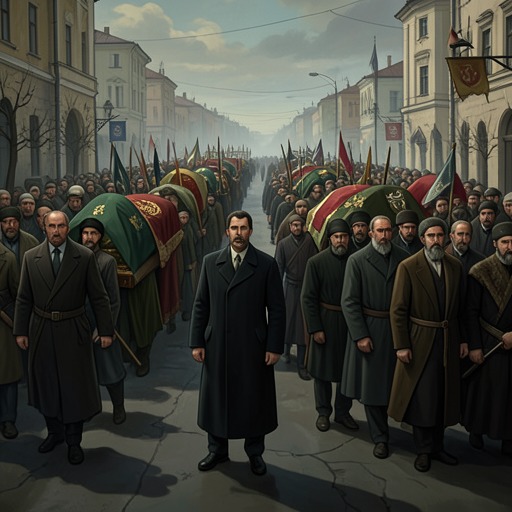
Akhtem’s funeral
Grey BeesAkhtem’s funeral is the moment when Sergey Sergeyich learns that his missing friend has been found dead and joins the Tatar community in mourning him. The return of Akhtem’s body turns the uncertainty surrounding his disappearance into a confirmed death, but the funeral also makes Sergeyich feel like a bee in an unfamiliar hive: close enough to accompany the mourners, yet unable to share their language or customs. His final, private gesture of respect and his return to the apiary connect grief with the work and life continuing around him.
The body is returned
The night before the funeral, Sergey Sergeyich sees a convoy of cars approach Albat along the Belbek. Their sirens and flashing red lights break the village’s quiet; after they stop near Aisylu’s house and fall silent, their presence makes the quiet feel unsettling rather than peaceful. Following the activity to the house, Sergeyich finds a crowd of about fifty people and policemen in mottled uniforms and black bulletproof vests. He wants to know what has happened, but hesitates over whom to ask: the Tatars speaking among themselves or the armed men speaking Russian.
A man tells him that the body of one of their men has been brought back. Sergeyich guesses that it is Akhtem. The answer confirms both the identity of the dead man and the terrible circumstance of his absence: Akhtem was found buried in the woods, and had been killed long before. Sergeyich looks toward the lighted windows of Aisylu’s house and asks why there are so many police, without taking his eyes from the living-room window. The news has resolved the question of Akhtem’s fate, but the armed presence around the house remains part of the scene he cannot understand.
Joining the mourners
The next morning Sergeyich hurries down from the apiary for the funeral. Before reaching the first houses, he brushes down his unironed trousers and tucks in his white shirt. His grey sports jacket does not seem right for the occasion, but it is the only jacket he has. Outside Aisylu’s house, a blue four-wheel-drive vehicle and a towering black Kamaz stand near three Berkut officers, who wear uniforms but no helmets. Their rubber batons hang at their belts as they talk. Inside the yard, people move in and out of the open house, speaking softly in Tatar. Sergeyich looks for Bekir or Aisha, too afraid to approach the house until he spots Bekir on the threshold.
A broad bench is carried into the yard, and Akhtem’s body, wrapped in a green pall embroidered with golden Arabic script, is placed on it. The visitors stand around the stretcher with space between themselves and the deceased. Sergeyich notices that all the men wear fezzes, and that he sees neither Aisylu nor Aisha near the body. An imam leads the prayer. Sergeyich understands none of the words, yet experiences the solemnity of the prayer physically as the men bow their heads toward their upturned palms.
A stranger in the procession
Friends and neighbours take turns carrying Akhtem’s body on their shoulders, supporting the stretcher with bent arms. Sergeyich follows at the rear. At the cemetery he stands to the side: not as far away as a detached observer, but not among those closest to the deceased. The speech around him remains Tatar. He begins to distinguish individual words, though their meanings remain inaccessible. The funeral draws him into the mourners’ shared passage from house to grave, while his position and partial understanding keep his outsider status visible.
At the grave, three men climb down into the narrow space to receive the body wrapped in green cloth. The burial continues under the hot sun, with a cricket sounding nearby. Later, Sergeyich notices that the men repeat words to one another and then exchange them with other men; he thinks of bees. The comparison gives form to a community whose speech he cannot follow: its exchanges are recognizable as social bonds, though their precise meanings remain beyond him.
A private farewell and the living apiary
Before leaving, Sergeyich turns his back to the yard so that no one will see him and crosses himself three times, thinking of Akhtem. The gesture is private, and it does not make him part of the funeral’s religious practice. Instead, it allows him to express his own mourning within a ceremony whose language and customs he has only partly grasped. He then returns to the apiary, to his own bees and Akhtem’s, whose buzzing he understands equally well.
A week after the funeral, Sergeyich checks on the hives. Akhtem’s bees are working too, undisturbed by their owner’s death. Their continued activity does not undo the loss; it sets the fact of death beside a living world that carries on. The funeral thus ends not with explanation or restored intimacy, but with Sergeyich’s return to the shared apiary and the quiet persistence of the bees.